
Risk Management · 2025
In this section2 topics
Risk Management Policy & Plan
Policy & Plan Description
Risk Management
Risk management is a crucial part of the company's business operations. The company has a policy to manage risks that may affect the company, both internal and external factors, to an appropriate and acceptable level, without impacting the principles of good corporate governance.
Organizational Risk Culture
The company recognizes that effective risk management requires cooperation from everyone in the organization. Therefore, to raise awareness and foster a culture throughout the organization, the company has fully implemented international standard practices.
Furthermore, the company encourages employees to understand the risk analysis process and be aware of potential risks within their units. The company promotes regular training for employees, executives, and directors to foster an understanding of risks and new risk management approaches that have arisen or may arise in the future.
Risk management is an integral part of the annual Business Plan development, ensuring that the defined risk management approaches align with the company's objectives, strategies, direction, and business goals.
Risk Management Process
The company mandates that all executives and employees within the organization are risk owners, responsible for assessing the risks of their respective units, including the effectiveness of existing risk control measures, and proposing plans and methods to mitigate such risks. The Executive Board/Risk Management Committee is responsible for compiling risks from each unit, assessing the company's overall risks, supporting the implementation of the risk management process, and reporting to the Board of Directors annually. The risk management process comprises 5 steps as follows:
Objectives Establishment
Risk Identification
Risk Assessment
Risk Treatment
Monitoring and Review
1. Financial Risk Refers to risks related to financial liquidity, financial management, and financial statements, such as risks from inappropriate budget allocation, erroneous budgeting, and budget overruns, as well as risks from market factor fluctuations (Market Risk) and risks from counterparties failing to fulfill their obligations (Credit Risk).
Guidelines for Financial Risk Management: Financial risks are managed as follows:
The company conducts analyses of customer credit quality and repayment ability, regularly reviews customer financial status, and makes adjustments as appropriate to prevailing circumstances.
2. Operational Risk Refers to risks that every business inevitably faces, arising from personnel, work processes, technology, and external factors. This risk occurs from normal business operations, including legal risks. Businesses must find ways to control and manage these risks to prevent their occurrence. If a business allows operational risks to accumulate, its performance may not meet expectations and could result in significant damage to the business.
Guidelines for Operational Risk Management: Operational risks are managed as follows:
Clear segregation of duties between the Board of Directors and management. A written delegation of authority chart is prepared to serve as an operational manual, ensuring all parties are aware of their operational or decision-making authority at all levels.
Monitoring and oversight are established to ensure operations align with policies and plans, by setting Key Performance Indicators (KPIs) for employees at all levels, who are required to develop risk management plans and report risk management progress to senior executives in various departments directly involved in risk management.
Efficient and auditable work processes are established, with regular inter-departmental meetings for consultation and knowledge exchange, drawing on past lessons and anticipating future opportunities to identify measures to prevent or reduce internal organizational risks to an acceptable low level.
Continuous risk management training is provided to employees at all levels to enhance their knowledge and experience, enabling them to recognize and effectively participate in risk management.
An effective and independent internal control system is established and regularly audited.
A data security system for critical operational data and a data backup system are established to accommodate potential emergencies. Clear regulations and procedures are also in place regarding data security policies and data systems to prevent data loss or leakage.
A business continuity plan is established to address unexpected emergencies that may affect the company's business operations.
3. Strategic Business Risk Refers to risks arising from inappropriate or inconsistent strategic planning, operational planning, and implementation with various factors such as government policies, legal changes, public relations issues, etc.
Guidelines for Strategic Risk Management: Strategic risks are managed as follows:
In managing and controlling the company's strategic business risks, an annual strategic plan is prepared, consistent with the company's long-term strategic plan. The company's Board of Directors participates in reviewing, approving, and endorsing the plan. Furthermore, a close monitoring process is in place at all levels to ensure that operations proceed according to the established plans and strategies. However, these strategic plans are regularly reviewed to align with changing circumstances.
4. Compliance Risk Refers to risks arising from violating or failing to comply with laws, regulations, or standards related to operations, and risks arising from not performing duties in accordance with policies and operational procedures established by the organization.
The factors of compliance risk are as follows:
Unintentional errors occur.
Personnel have the intention or willingness to commit wrongdoing or fraud.
Deficiencies in work methods/procedures.
Planning and actual implementation are not consistent with requirements.
Legal provisions, regulations, and announcements are interpreted by operational staff.
Misunderstanding in communicating messages according to rules.
Misinterpretation occurs.
Inadequate communication of rules to all departments.
Published information regarding rules and laws is incorrect.
Guidelines for Compliance Risk Management are as follows:
The company regularly monitors and reviews laws and regulations related to business operations to ensure compliance with regulatory requirements.
The company clearly defines internal policies, regulations, and operating procedures to enable employees to perform their duties correctly in accordance with relevant laws and standards.
The company regularly supervises and audits operations to reduce the risk of non-compliance with requirements.
The company selects and evaluates relevant partners and service providers to ensure operations comply with established laws and standards.
5. Organizational Fraud / Corruption Risk Refers to any act to unlawfully seek benefits, whether it be giving or receiving bribes, political assistance, giving gifts or hospitality, charitable donations, reception services, or other expenses, by offering, promising, pledging, demanding, giving, or receiving money, assets, or any other inappropriate benefit to government officials, government agencies, private entities, or persons with duties, whether directly or indirectly, and in any form, to induce such agencies or persons to act or refrain from acting in their duties, to obtain or maintain business benefits for the company, oneself, family, friends, and acquaintances, or for undue business advantage, especially if such act results from improper authorization or violates the law, or any act that suggests corruption, unless permitted by law, customs, traditions, or trade practices.
Guidelines for Organizational Fraud / Corruption Risk Management Risk management is implemented, with the Board of Directors, executives, employees at all levels, and all relevant departments, as well as individuals or other legal entities acting on behalf of the company or individuals hired on a temporary contract basis, having a duty to strictly adhere to the company's anti-corruption policy and business ethics, as follows:
The Board of Directors, executives, and employees shall not commit or support corruption under any circumstances and shall strictly adhere to anti-corruption measures.
The Board of Directors, executives, and employees will foster an organizational culture of integrity and adherence to fairness.
The company provides communication and training to employees within the organization to promote integrity in their duties and to ensure they are ready to adopt the principles and ethics of good corporate governance policies as operational guidelines throughout the organization.
The company establishes human resource management processes that reflect its commitment to anti-corruption measures, from selection, training, performance evaluation, compensation, and promotion.
The company establishes internal audits to ensure that the internal control system helps the company achieve its objectives, as well as to verify that all departmental operations comply with requirements and regulations, and to identify deficiencies and weaknesses, providing recommendations for developing operational systems to be efficient and effective in accordance with good corporate governance policies and anti-corruption policies/measures.
Risk Assessment
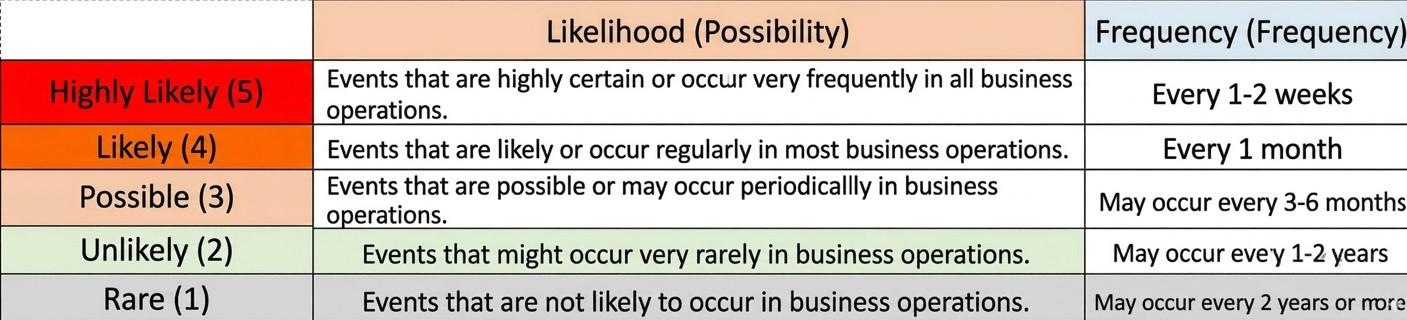
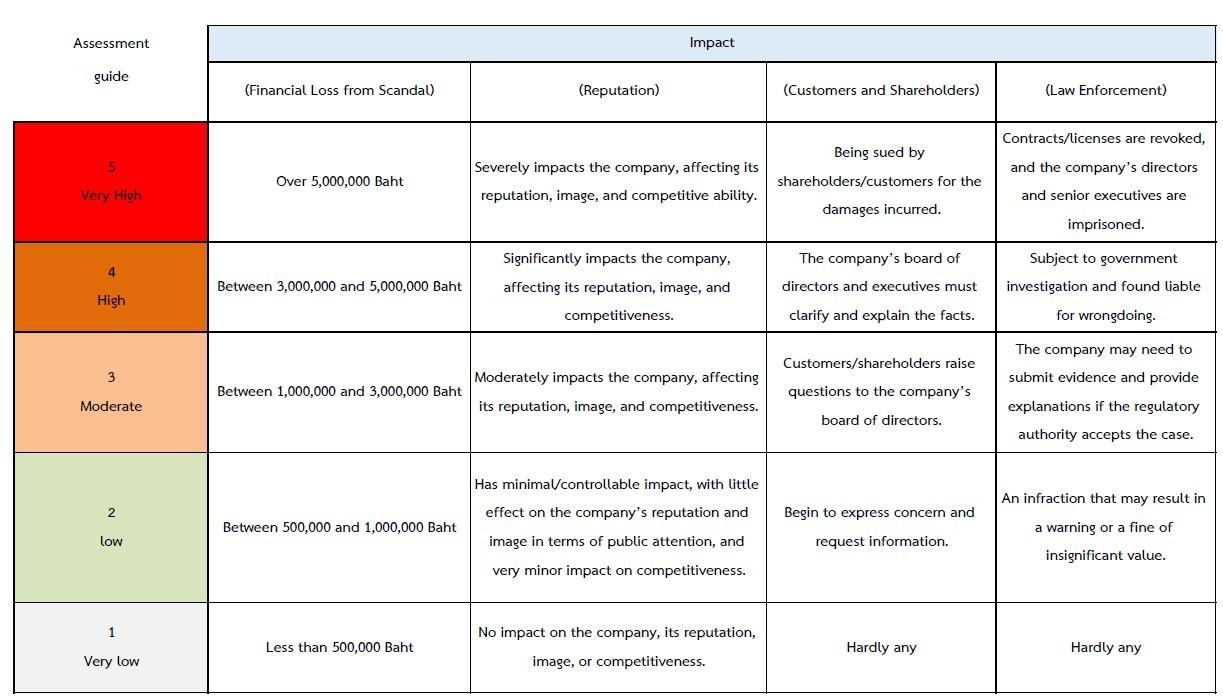
Risk assessment is a process comprising the analysis, evaluation, and grading of risks that impact the achievement of organizational operational objectives. The company has established risk assessment criteria, namely the level of likelihood of risk (Likelihood) and the level of impact severity (Impact), which can be defined using both quantitative and qualitative criteria as a basis for assessing various risks.
The level of likelihood of risk events (Likelihood) is set at 5 levels as follows:
Level of Impact Severity (Impact) Criteria are set at 5 levels as follows:
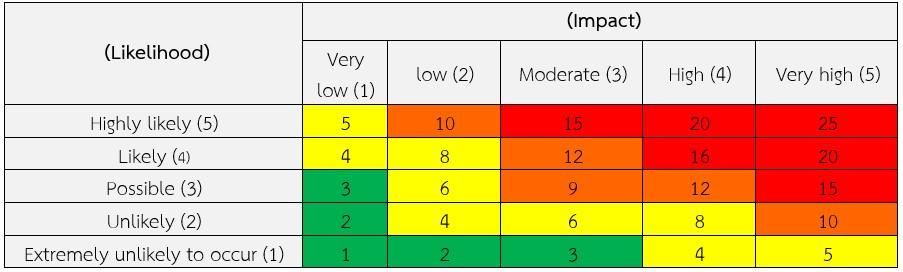
Risk Level = (Likelihood of various events) X (Impact of various events)
Risk Map
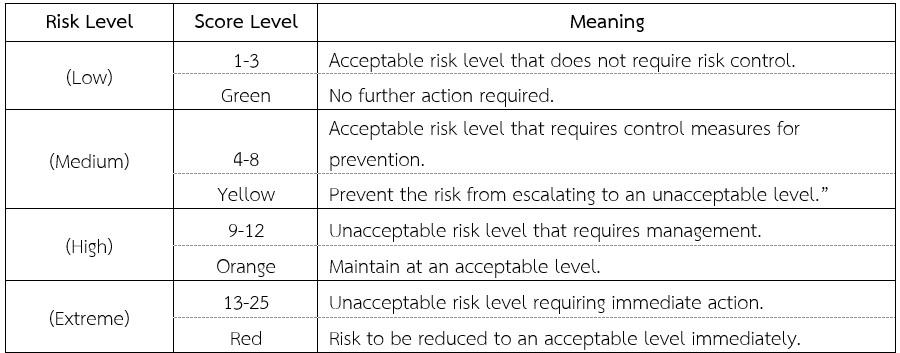
Risk levels are divided into 4 levels and can be presented as a (Risk Profile) with the following classification criteria:
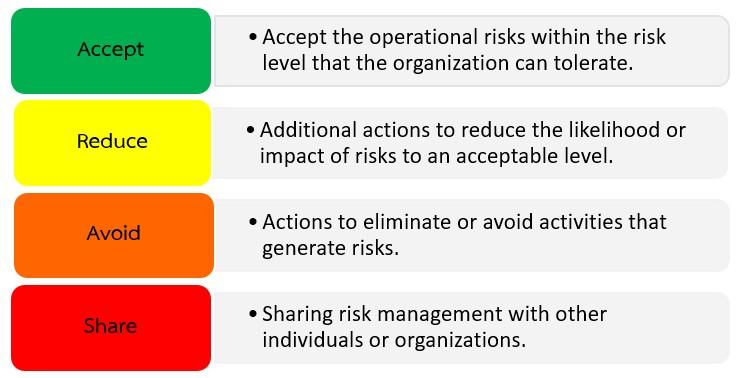
Risk Management Strategies
Risk Management
The risk management plan will be presented to the Executive Committee meeting for consideration and approval of necessary resource allocation (if any). In selecting the most appropriate risk management approach, consideration will be given to risk tolerance versus incurred costs compared to benefits received, as well as relevant laws, other regulations, and social responsibility.
Monitoring and Review
The risk management process implemented within the company must be communicated internally for the purposes of risk assessment, monitoring risk management progress, and continuously tracking trends of key risks, including the occurrence of unusual events. This is to ensure that risks with significant impact on achieving organizational objectives are reported regarding risk management progress and risk trends to responsible executives, the Executive Board, the Risk Management Committee, and that the established internal control systems are adequate, appropriate, effective, and actually implemented to prevent or reduce potential risks, as well as being continuously updated to align with changing situations or risks.
Risks to the Company's Business Operations
Risk Register
| Risk Name | Risk Characteristics | Consequences | Management Measures | Related Risk Factors |
|---|---|---|---|---|
| Risk of reliance on key contract manufacturers | the risk of reliance on a key contract manufacturer When engaging a contract manufacturer for skincare products, the Company will participate in product formula development with the contract manufacturer, determining the overall direction of the product, specifying key extracts or raw materials to be used as ingredients in the production formula, and defining the product's properties to meet the needs of the target customer group for that product. This allows 2-3 contract manufacturers to innovate and develop product formulas for presentation to the Company. Once a contract manufacturer is selected, the Company will engage only that manufacturer for the specific product. The product formula and the product notification number registered with the Food and Drug Administration (FDA), Ministry of Public Health, are considered the intellectual property of the contract manufacturer. For the years 2023, 2024, and 2025, the Company has engaged a total of 7 contract manufacturers. Among these, one contract manufacturer producing skincare products for the Company accounted for 98.43%, 90.24%, and 82.69%, of the total production orders for each respective year. Therefore, should this contract manufacturer be required to cease production for the Company, it could potentially impact business operations. However, in 2025, the proportion of engagement with this contract manufacturer decreased as the Company expanded its business into the Make Up Care product category from late 2024. Consequently, other contract manufacturers specializing in Make Up Care products were engaged to produce these goods. The proportion of production orders for each existing contract manufacturer, when compared to the total production orders for all products during the period, therefore decreasing | Should the aforementioned contract manufacturing plant be compelled to cease production of goods for the company, it could adversely affect business operations. | The company has manufacturing agreements with all factories, stipulating that the product formula and product notification number are considered joint copyrights between the company and the contract manufacturing factory. Furthermore, there is a provision that the contract manufacturing factory cannot disclose the product formula or produce those products for any other party. Additionally, there is a provision that in the event the contract manufacturing factory is unable to produce and deliver the goods, the company can take the formula for that skincare product to be manufactured by other contract manufacturing factories. This is to mitigate the aforementioned risks. In the future, the company has a policy to engage more new contract manufacturing factories. Therefore, the company believes that such risks are unlikely to affect its operations. However, this contract manufacturing factory has been operating in the skincare product contract manufacturing business since 1990. It has a stable business status, and a review of its past financial statements reveals good operating results and profitability. The company has engaged this factory for manufacturing since 2013 and has never encountered any issues from contract manufacturing. Furthermore, the partner evaluation results, which the company conducts annually, have consistently been at a good level. In engaging a contract manufacturing factory, the company considers the quality of skincare product manufacturing to ensure the products meet the company's desired specifications, after comparing product samples from other contract manufacturing factories based on appearance, scent, color, texture, properties, and manufacturing costs, etc. According to the provisions of the manufacturing agreement between the company and the aforementioned factory, the product formula and product notification number are considered joint copyrights between the company and the contract manufacturing factory. Furthermore, there is a provision that the contract manufacturing factory cannot disclose the product formula or produce those products for any other party. Additionally, there is a provision that in the event the contract manufacturing factory is unable to produce and deliver the goods, the company can take the formula for that skincare product to be manufactured by other contract manufacturing factories. This is to mitigate the aforementioned risks. In the future, the company has a policy to engage more new contract manufacturing factories. Therefore, the company believes that such risks are unlikely to affect its operations. | 734 · Description: Reliance on large customers or few customers · Info category: STRATEGIC_RISK |
| Risks from dependence on convenience store distribution channels | Risk from Reliance on Major Convenience Store Distribution ChannelsThe Company distributes its skincare products through a diverse range of channels, including convenience stores, health and beauty stores (H&B), hypermarkets, traditional trade, and e-commerce. A significant portion of the Company’s core revenue is derived from products in sachet format, which are primarily sold through convenience stores. As a result of the Company’s strategic initiative to diversify distribution channels and mitigate over-reliance on any single partner, the revenue proportion from one major convenience store operator has shown a consistent downward trend. For the years 2023, 2024, and 2025, revenue from this specific retailer accounted for 61.44%, 52.65%, and 44.81% of total sales revenue, respectively. Despite this significant reduction in dependency, the current revenue contribution of 44.81% remains substantial to the Company’s overall financial performance. Consequently, any material changes to commercial terms—such as an increase in gross profit (GP) sharing rates, the imposition of minimum sales targets, or the potential delisting of products should sales performance fail to meet agreed benchmarks—could significantly impact the Company’s revenue and operating results. | If that convenience store adjusts significant commercial terms, such as the minimum sales volume or the revenue sharing rate for the convenience store (GP fee), it could significantly impact the company's product sales revenue and operational performance. | The Company has a strategic plan to reduce the proportion of sales revenue received from the aforementioned major convenience stores, in order to appropriately diversify revenue proportions from each distribution channel. Therefore, the Company believes there will be no risk issues as mentioned above. However, the Company also continuously focuses on expanding new distribution channels. To date, products are sold through a total of 13 channels and stores, to ensure comprehensive consumer access and to mitigate the aforementioned risks. The Company prioritizes maintaining good relationships with all distribution channel stakeholders by consistently cooperating in campaigns and marketing promotion activities notified by various distribution channels, and every time new products are launched, to stimulate sales through various distribution channels. Furthermore, it has acted as a good business partner, leading to continuous renewal of commercial contracts with convenience stores. In addition, the Company has a strategic plan to reduce the proportion of sales revenue received from the aforementioned major convenience stores, in order to appropriately diversify revenue proportions from each distribution channel. Therefore, the Company believes there will be no risk issues as mentioned above. However, the Company also continuously focuses on expanding new distribution channels. To date, products are sold through a total of 13 channels and stores, to ensure comprehensive consumer access and to mitigate the aforementioned risks. | 745 · Description: Loss or damage from non-compliance of partners or counterparties · Info category: OPERATIONAL_RISK |
| Risk from high competition and changes in consumer behavior | Risks from high competition and changing consumer behavior
| Currently, individuals are increasingly influenced by influencers, leading to a heightened focus on personal image and self-care. This trend, coupled with the low capital investment required to start a business and the ability to outsource production to standardized manufacturers of skincare and cosmetic products, simplifies market entry. Additionally, the widespread availability of e-commerce platforms and numerous convenience stores for product distribution further lowers the barrier to entry for entrepreneurs in the beauty and personal care sector, attracting both domestic and international competitors. | The Company focuses on product quality, developing existing products to improve quality in line with evolving technology and to make them appealing, building a recognizable brand, product reliability, promotions, and distribution channels. Furthermore, there is monitoring of changes in consumer behavior, including communication with consumers, interviewing consumers, and soliciting feedback from product testers, as well as conducting study tours abroad to update knowledge on products and various extracts in skincare products to keep up with current trends. | 729 · Description: Behavior or needs of customers / consumers · Info category: STRATEGIC_RISK · 1714 · Description: Competition risk · Info category: STRATEGIC_RISK |
| Risk of irritation or allergic reactions from product use by consumers (Product Liability) | The company's products are for facial and body use, which are delicate and sensitive areas. This poses a risk of skin irritation or allergic reactions for consumers, which may lead to claims for compensation or damages against the company, and could also affect the credibility of the company's products. Therefore, the company places importance on selecting contract manufacturing facilities, choosing those that meet GMP (Good Manufacturing Practice) standards or ISO 22716:2007 standards. For the raw materials used in production, only high-quality materials with certified research reports are selected. Furthermore, before any product is released for sale, various quality tests are mandated, such as sending product samples to trial test groups (Trial Test), product stability testing to prevent separation (Stability Test), safety testing by specialized dermatologists (Dermatologist Test), packaging compatibility testing (Compatibility Test), and external physical inspection (Appearance Check), among others, to ensure that the products sold will not cause subsequent issues. The company's products undergo various aforementioned procedures, especially safety testing by specialized dermatologists (Dermatologist Test), to ensure that the likelihood of adverse effects from product use, as mentioned, is very low. This is because the company uses raw materials as components that comply with regulations or have received approval from the Food and Drug Administration (FDA), and implements various testing procedures, including testing on an appropriate number of individuals for each product. In the event that a user of the company's products claims damages, that user must prove that the damage resulted from substandard production or low-quality raw materials, which genuinely caused the individual to be affected. This must be determined based on the results of an examination by a specialized dermatologist. If proven, the company is willing to be responsible for such damages according to the actual expenses incurred. To date, the company has not received any complaints from the Office of the Consumer Protection Board (OCPB). However, should there be any claims requiring the company to take responsibility and be proven as stated, the company also has contractual agreements with its contract manufacturers, stipulating that the contract manufacturers are responsible for product quality when used and stored as indicated on the packaging. Furthermore, the company has secured legal liability insurance for damages arising from unsafe products, with a maximum insured capital sum not exceeding 40 million Baht per incident and throughout the insurance period. The policy will be renewed on an annual basis. The insurance period for the currently effective policy is January 1, 2025 – January 1, 2026. The company will continuously renew the policy but will adjust the insured capital sum upwards to align with the business size at the time of future insurance renewals. | Should consumers experience irritation or allergic reactions from using the product, this could lead to the company being subject to legal claims for damages or compensation. Furthermore, it may adversely affect the brand image, product credibility, and consumer trust, potentially impacting the company's sales and operational performance in the long term. | In the event of a complaint, the company has a process for investigation and fact-finding conducted by dermatologists. The company is prepared to be responsible for damages based on actual expenses incurred if it is proven that the cause is due to substandard production or raw materials. Furthermore, the company has a contract specifying product quality liability with its contract manufacturers and has arranged legal liability insurance for unsafe products, with a maximum coverage limit not exceeding 40 million Baht per incident. The policy is renewed annually, and the coverage limit is continuously adjusted to suit the business size. | 729 · Description: Behavior or needs of customers / consumers · Info category: STRATEGIC_RISK · 736 · Description: Damage to company image and reputation · Info category: STRATEGIC_RISK |
| Risks from warehouse rental for goods storage | Currently, the company does not possess its own storage warehouse. Consequently, it has leased one warehouse to serve as a fulfillment center, aiming for rapid delivery of products to recipients. Therefore, the company is unable to monitor products in real-time. Should products be damaged, defective, or lost, it could adversely affect the product's image and erode customer confidence in the company's offerings. However, the warehouse service provider will submit a stock report to the company every Friday. Upon receiving the report, the company will cross-reference the figures from the report with the inventory figures prepared by the accounting department to prevent product loss. Furthermore, at the end of each quarter, personnel will be dispatched to conduct a stock count at the warehouse. Should any damage or loss of goods be identified, the company will request CCTV footage from the warehouse service provider to ascertain whether the damage or loss resulted from storage or transportation. If the incurred damage or loss is attributable to product storage, the contract stipulates that the warehouse service provider shall be responsible for the associated costs. In cases where the damage is caused by flood or fire, the company will be compensated for the actual damage up to the value specified in the warehouse lease agreement. | Should goods be damaged, defective, or lost due to storage in the leased warehouse, this could result in the company being unable to deliver products on schedule, leading to damage to goods and increased operational costs. Furthermore, it could impact the product's image, customer trust, and satisfaction with the service, potentially affecting the company's sales and long-term performance. | The Company has established risk control measures for warehouse leasing by selecting warehouse service providers with appropriate management and security systems. The service provider will submit weekly inventory reports to the Company, which the Company will regularly verify and reconcile with the accounting department's inventory data to prevent errors and loss of goods. Additionally, the Company will conduct quarterly inventory counts at the leased warehouse. In the event of damage or loss, the Company will request CCTV footage from the warehouse service provider to analyze the cause. If the damage is due to product storage, the warehouse service provider will be responsible for the compensation as stipulated in the lease agreement. In cases of damage caused by floods or fires, the Company will be compensated for the actual value within the limits specified in the contract. The Company will continuously monitor and review the effectiveness of these control measures. | 741 · Description: Systems or internal control system · Info category: OPERATIONAL_RISK |
| Risk from counterfeit products | As the company strives to build brand recognition, concepts, trademarks, and foster brand loyalty among customers through marketing investments, and also focuses on participating in the development of quality skincare products for consumers at affordable prices, unscrupulous individuals may exploit the company's brand image to create counterfeit products and mislead consumers. For instance, producing low-quality counterfeit products could cause irritation or allergic reactions in consumers, which would directly impact the company's image, reputation, and operational performance. However, the company advises consumers to purchase products from reliable distribution channels, as these are the channels through which the company directly distributes its products. Examples include purchases through 7-11, Watsons, Shopee, and Lazada. The company has also promoted its brand image, concepts, and trademarks across various channels to build brand awareness. Furthermore, the company has registered its trademarks and the key proprietary extracts used as ingredients to prevent unauthorized use of its trademarks and proprietary ingredient extracts. | Should there be product imitation or unauthorized use of the company's recognizable images, concepts, and trademarks, consumers may be misled regarding the origin or quality of the products. Particularly, in cases of substandard counterfeit products, this could lead to irritation or allergic reactions, thereby impacting the brand's image, reputation, credibility, and consumer confidence. Such incidents could ultimately affect the company's sales and operational performance in the long term. | The company has established measures to prevent and manage risks related to product counterfeiting by publicizing to consumers to purchase products through reliable distribution channels and channels where the company directly distributes products for sale, such as 7-Eleven convenience stores, Watsons stores, and online platforms like Shopee and Lazada. Additionally, the company continuously communicates its brand image, concepts, and trademarks through various channels to build brand awareness and reduce consumer confusion. Furthermore, the company has registered its trademarks, including registering key extracts that are proprietary ingredients of the company, to protect intellectual property and prevent misuse. It also continuously monitors and guards against product counterfeiting to maintain the brand's image and credibility in the long term. | 736 · Description: Damage to company image and reputation · Info category: STRATEGIC_RISK |
| Risk from the inability to count stock for consigned goods. | As the consignment partners with whom the company consigns its products do not permit the company's representatives to conduct inventory counts at the consignee's premises and various branches where the company's products are consigned, consequently, the company must rely on sales summary reports from the consignment partners to verify the quantity of goods sold. Therefore, the company assigns the Supply Chain Department to reconcile the inventory balance in the D-Account system with the sales summary reports from the consignment partners on a monthly basis to ensure that the quantity of goods dispatched to each consignment partner and the quantity of goods sold as per the consignment partners' sales summary reports are accurate and consistent, and to prepare a reconciliation report for the inventory balance in the D-Account system and submit the reconciliation report and inventory report to the Accounting Department at the end of each month. The Accounting Department will verify the accuracy and send emails to the consignment partners to confirm the inventory balance. However, one consignment partner, accounting for over 50% of the company's product sales revenue, charges a 'No Damaged Goods Return' fee. This implies that if any goods are lost or damaged, the consignment partner will compensate the company for the goods as if the said consignment partner had sold them. For the other two consignment partners, the company will be responsible for any lost or damaged goods. Consequently, the 'No Damaged Goods Return' condition, which would incur additional costs for the company, was not negotiated. This is because the consignment partners selected by the company are reputable and have storefronts located within department stores equipped with robust security systems, in addition to their own store security. Therefore, the likelihood of goods being lost is very low. | The company's inability to directly inspect and count inventory at the consignment partner's point of sale may necessitate a primary reliance on sales summary reports and inventory data from the partner. This could lead to risks arising from data inaccuracies or delays in reporting such information. Should errors occur, they could impact the accuracy of the company's inventory accounting and revenue recognition. | The company has established measures to mitigate such risks. This involves assigning the Supply Chain department to regularly review and reconcile the inventory balance in the D-Account system with the sales summary reports from consignment partners on a monthly basis, ensuring that the quantity of goods sent to partners and the quantity sold are accurate and consistent. Furthermore, the company prepares inventory reconciliation reports and submits them to the accounting department for further verification. Additionally, the accounting department is instructed to regularly confirm inventory balances with consignment partners via email at the end of each month to enhance the accuracy and reliability of the data. The company selects reliable consignment partners with appropriate security systems to mitigate the risk of loss or damage to goods. | 741 · Description: Systems or internal control system · Info category: OPERATIONAL_RISK · 742 · Description: Human error in business operations · Info category: OPERATIONAL_RISK |
| Risk of incomplete legal compliance | Currently, the company operates a business involving the research, development, contract manufacturing, and distribution of skincare products and cosmetics, which must comply with relevant laws and regulations, such as the Cosmetics Act B.E. 2558 (2015) and Ministry of Public Health announcements related to the criteria, methods, and conditions for the production or import of cosmetics. Although the company is not a direct manufacturer, if the contract manufacturing facilities utilized by the company do not possess complete licenses or fail to comply with legal requirements, it could adversely affect the company's business operations. | If the company or contract manufacturing plant fails to fully comply with relevant laws and regulations, it may result in the company incurring penalties as prescribed by law, such as fines or criminal penalties for the involved directors or executives. Furthermore, it could lead to the suspension of production or sale of goods, product recalls, and may also impact the company's reputation, consumer confidence, and operational performance. | The company recognizes the importance of compliance with relevant laws and regulations. Therefore, it has established a clear process for selecting contract manufacturing facilities. The facilities utilized by the company must possess valid operating licenses and operate in accordance with the criteria of the Cosmetics Act B.E. 2558 (2015), as well as other related regulations. Furthermore, should any legal issues or concerns arise, the company may consider engaging legal advisors to provide advice, conduct reviews, and propose appropriate solutions or mitigation measures for potential impacts. | 1723 · Description: Legal risk · Info category: COMPLIANCE_RISK |